


Agentic AI Blueprint: Unlocking Business Value with AI Agents
What is the Agentic AI Blueprint Program?
The Agentic AI Blueprint: Unlocking Business Value with AI Agents online program from Kellogg Executive Education equips professionals to translate business requirements into agentic AI system designs and establish the governance principles needed for responsible adoption at scale.
Across eight modules, participants progress from identifying and prioritizing an AI opportunity to designing structured prompts and multi-agent architectures. The comprehensive learning experience combines applied exercises across leading AI platforms and a program-long capstone project, culminating in an implementation-ready blueprint for an agentic AI system designed around a real organizational opportunity.
What Will You Learn in the Agentic AI Blueprint Program?
Key Program Takeaways
AI decision reliability: Assess the reliability of AI-driven decisions based on context, data quality and human oversight.
Agentic automation: Identify business workflows best suited for agentic automation based on value and feasibility.
Agent system requirements: Define the personas, outcomes, data and workflow requirements for an agent system.
Multi-agent architecture: Design a multi-agent architecture for a complex business outcome.
Prompt PRD development: Develop a Prompt Product Requirements Document (PRD) that defines an agent system’s knowledge, decision rules, actions and safeguards.
Governance and scaling: Evaluate governance and scaling considerations for responsible organizational adoption.
How Is the Agentic AI Blueprint Program Curriculum Structured?
Module 1: The Brain of AI
Examine how AI creates value through role automation and examine the differences between human and AI decision making. Identify how context, data quality and oversight affect AI reliability, and pinpoint a workplace or societal problem AI could help address.
Module 2: Managing and Achieving Outcomes With AI
Prioritize potential AI opportunities using value and feasibility criteria while defining the desired outcomes, users and data requirements.
Module 3: The Four Workflows of AI
Identify which of four AI workflow types best support the use case, determine the required data inputs and outputs and map the surrounding data ecosystem.
Module 4: Playground — Hands-On With AI Tools and Agents
Gain guided, practical experience across multiple AI platforms by applying concepts from earlier modules to build assistants, prototypes and specifications and compare outputs, reliability and data considerations across tools.
Module 5: AI Prompt Engineering: Prompting Is the New Executive Skill
Treat prompting as an executive capability. Match AI models and intelligence levels to task requirements, then progressively refine a structured prompt using context, persona and a reusable skill.
Module 6: The Five Agents That Matter
Explore five agent types and the semantic understanding, data, actions, governance and orchestration that enable agent systems to operate effectively.
Module 7: From Data PRD to Prompt PRD: Multi-Agent Architecture
Using tax automation as a real-world example, learn how to define the purpose, knowledge, decision rules and oversight requirements of a complex agentic AI system. Apply the framework to your own opportunity to develop a Prompt PRD that brings these elements together.
Module 8: Agentic AI Governance and Scale — The Inches That Matter
Examine the governance and scaling decisions required for responsible adoption. Apply the Find It, Bottle It, Scale It framework, and consider data sovereignty, cost and the effects of AI on communities and national interests.
How Does This Program Equip You for Real-World Impact?
Program Highlights

Expert faculty
Learn from Kellogg faculty with deep expertise in AI strategy, agent design and organizational governance.

Applied learning
Translate emerging AI opportunities into agentic AI blueprints spanning workflows, data, governance and implementation.

Signature frameworks
Apply frameworks including the Data PRD, five-agent taxonomy and Prompt PRD to evaluate opportunities and structure solutions with greater clarity.

AI platform experience
Work directly with ChatGPT, Claude Projects, Manus, NotebookLM and DeepSeek to build assistants, prototypes and prompts while exploring how these tools support broader agent-based workflows.

Capstone project
Develop an agentic AI blueprint for a real business opportunity, complete with implementation, governance and scaling considerations.

Industry-inspired cases
Work through use cases on agentic AI spanning AlphaFold, agricultural data ecosystems, tax automation and platform-driven decision making to ground agentic AI concepts in real-world application.

Governance-focused design
Address human oversight, risk, data sovereignty and organizational readiness as core design considerations in AI agent systems from the outset.

Self-paced learning
Follow a structured learning experience that allows time for reflection, discussion and application between modules.
Capstone Project
The capstone project is a progressive assignment in which you select a meaningful organizational or societal problem and design a conceptual agent system to address it. Each module of the curriculum contributes a distinct artifact or design decision, letting you test assumptions and refine the proposed system as your understanding of key concepts develops.
Module 1: Define a Problem Hypothesis that identifies the organizational or societal challenge the participant’s agent system will address.
Module 2: Develop an AI Opportunity Brief that brings together a target persona, a scored Problem Hypothesis and a data vision statement.
Module 3: Apply frameworks to the selected opportunity, integrating artifacts from Modules 2 and 3.
Module 4: Complete a cross-platform reflection comparing outputs, reliability, limitations and the need for human oversight across two or more platforms.
Module 5: Produce a Structured Prompt Prototype and compare pre- and post-refinement outputs.
Module 6: Develop a Multi-Agent Architecture Blueprint that defines each agent’s role, decision boundaries and system requirements. This blueprint will inform the Prompt PRD developed in Module 7.
Module 7: Produce a Structured Prompt Prototype and compare pre- and post-refinement outputs.
Module 8: Submit governance and scaling guidelines addressing cost, data use, community impact, human oversight and audit requirements, culminating in a Governance and Scaling Brief.
Who Is This Agentic AI Program For?
Business and product leaders driving growth, innovation and AI-enabled initiatives | Gain a structured way to identify high-value opportunities to deploy agents and develop practical blueprints for adoption and execution. |
AI, data and technology leaders owning AI strategy, technology adoption and enterprise readiness | Obtain frameworks to assess and lead AI initiatives that align with business objectives. |
Consultants and transformation advisors guiding clients through AI adoption and operating-model change | Find a repeatable methodology that connects business challenges to viable agentic AI opportunities. |
AI product and solution professionals, including product managers, business analysts and solution architects working alongside AI teams | Translate business requirements into enterprise-wide agentic AI workflows. |
Meet the Program Faculty

Birju Shah
Clinical Assistant Professor of Marketing
Birju Shah is a seasoned product leader, entrepreneur and educator with more than 20 years of experience building and scaling innovative AI and machine learning (ML) products ...
What Credentials Will You Earn?
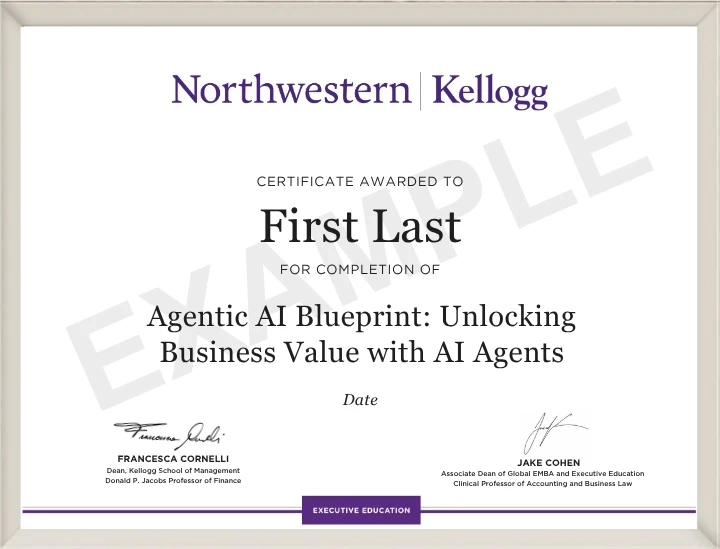
Upon successful completion of the program, Kellogg Executive Education grants a verified digital certificate of completion to participants. This program is graded on a pass/fail basis. Participants must achieve a score of 80% or higher to pass and obtain the certificate of completion.
After completing the program, your verified digital certificate will be emailed to you in the name you used when registering for the program. All certificate images are for illustrative purposes only and may be subject to change at the discretion of Kellogg Executive Education.
Note: This online certificate program does not grant academic credit or a degree from the Kellogg School of Management.
Frequently Asked Questions (FAQs)
Program
What is the best agentic AI certification for business professionals?
The best agentic AI course for you will depend on your goals and requirements. The Agentic AI Blueprint: Unlocking Business Value with AI Agents program is an eight-week agentic AI course for working professionals in business, product and technology roles. It is graded on a pass/fail basis and awards a digital certificate of completion from Kellogg Executive Education. It does not provide any industry-recognized certification or academic degree.
Can I learn agentic AI without coding knowledge?
The program introduces intelligent systems and multi-agent design through real-world scenarios and does not require coding experience. A basic understanding of generative AI and machine learning concepts is recommended.
What is the best agentic AI course for beginners in business roles?
This Kellogg Executive Education program introduces intelligent systems and multi-agent design through real-world scenarios, without assuming prior AI expertise. Each module’s key learnings build toward informed decisions on where to integrate AI in your organization.
How do large language models work, and does this program explain that?
Module 1 explains how large language models work at a conceptual level while exploring how AI creates value, how human and AI decision making differ and what influences the reliability of AI-driven decisions.
Does the program cover multi-agent systems and multi-agent orchestration?
Yes, Module 6 teaches a five-agent taxonomy for designing multi-agent systems, covering multi-agent orchestration, multi-agent collaboration and how multiple agents share data, actions and governance within one architecture.
What is agentic AI vs. generative AI, and does the program cover both?
Generative AI and gen AI tools typically focus on creating content or responses based on user inputs, while agentic AI extends these capabilities by using agents to carry out actions and coordinate complex tasks within defined workflows. Agentic AI design is the primary focus of this program.
What prompt engineering techniques will I learn?
Module 5 treats prompting as an executive skill, teaching prompt engineering techniques to optimize prompts for context, persona and task requirements — refining them to produce more reliable outputs.
Does the program involve building or deploying AI agents?
The program focuses on designing blueprints to build autonomous systems rather than the AI engineering work of coding and shipping production-ready AI agents.
Does the program cover retrieval-augmented generation or model context protocol?
No dedicated technical module covers retrieval-augmented generation or the model context protocol. The program addresses, at a conceptual level, how agents connect AI systems to external tools and data as part of architecture design.
Will I require paid subscriptions to AI tools to complete the assignments?
No, all versions of AI tools used for mandatory activities are free. However, learners may upgrade to premium tools if they so choose.
Learning Experience
What AI platforms or tools will I use during the program?
The curriculum includes hands-on work across five platforms — ChatGPT, Claude Projects, Manus, NotebookLM and DeepSeek — on which you will design custom tools to build assistants and prototypes, practicing tool use and comparing outputs.
Is there a pre-work module or research component before the program starts?
The program includes an orientation week that functions as Module 0. Beyond orientation, there is no separate pre-work module or web-based research phase. All required learning activities are included within the eight-module curriculum.
Are there mentorship sessions included in the program?
There are no dedicated mentorship sessions with program faculty. However, a program leader is available to offer support throughout the learning experience.
Is there a free certification for agentic AI?
No. Agentic AI Blueprint is a paid professional education program that awards a digital certificate of completion to participants who successfully complete the program.
Refund Policy
What is the program refund and deferral policy?
For the program refund and deferral policy, please click the link here.
Accessibility
How does Emeritus support accessibility for learners?
Emeritus is committed to making high-quality education accessible and affordable to individuals, companies and governments around the world. If you have questions about accessibility or would like to discuss available support options before enrolling, please contact accessibility@emeritus.org. For more information about our accessibility practices, please review our Accessibility Policy here.
Credit Partners
Climb Credit*
We offer financing options with our partner, Climb Credit*. Click here to learn more.
*Applicable for US Residents
Didn't find what you were looking for? Write to us at learner.success@emeritus.org or Schedule a call with one of our Program Advisors or call us at +1 315 502 3308 (US) / +44 128 291 1923 (UK) / +65 3129 4131 (SG)
Flexible payment options available.
Starts On